How Changing Career Trends Are Reshaping Post-Secondary Preparation

In recent decades, the default definition of post-secondary success has often been linked to college degrees. But things have changed.
Six years after we learned the word ‘COVID,’ the pandemic is reshaping how younger generations are viewing career paths. The technological innovations that came with going remote have made trades and industries more accessible, with self-guided tutorials now a popular way to learn skill basics.
While some students dream of attending college or university after graduating high school, others may be passionate about trade careers, entrepreneurship, military service, travel or entering the workforce. Recent research from Gallup and the Lumina Foundation reinforces this shift.
“Despite the perceived importance of higher education, pathways to enrollment and completion are unclear or inaccessible to many U.S. adults,” the report states. “Financial pressures and personal circumstances heavily shape decisions about whether and where to enroll. These pressures rarely end after high school graduation: Student debt continues to weigh on borrowers’ financial stability and constrain major life decisions long after they leave campus.”
Statistics from the report show that 73% of U.S. adults still connect college degrees with career success, while 58% are interested in pursuing a degree or credential. Access, however, remains an obstacle, with only 25% saying most people in the U.S. have access to quality, affordable education after high school—a statistic that has gone down 10 percentage points since 2023.
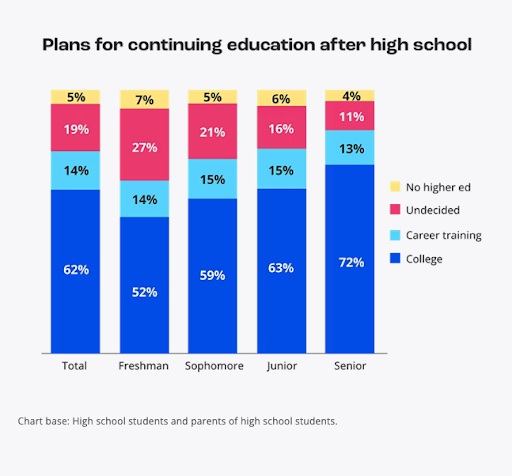
Overall, the majority of high school students (95%) plan to pursue post-secondary education, with 68% eyeing a two- or four-year college. That still leaves more than a quarter (27%) with post-secondary goals that are not associated with a college or university.
The reality is that the path after high school looks much different for everyone, and the most effective educators recognize that student success looks different for every learner.
Navigating multifaceted career-readiness
Since 2015, Americans’ confidence in higher education has declined from 57% to as low as 36%, showing a need for diverse career preparation. Recently, the Workforce Pell Grant was introduced to connect students with 8- to 15-week certificate programs to encourage workforce development.
This evolution is also a response to a generation that has created its own definition of success.
Generation Z has gained a reputation in recent years for being the most entrepreneurial generation. Teens and young adults are leveraging their tech abilities to build e-commerce sites, create apps and dip into content creation, presenting new and exciting options after high school graduation.
The "How America Plans for College in 2026" report visually breaks down students' sentiments about life as high school graduates. While college is well represented, there are still students who need a different type of preparation from their college-bound counterparts.
Students who plan to enter the trade industry, for example, say they prefer hands-on, practical learning (40%) and the security of high-demand skilled trades or technical roles. While college offers these opportunities, they are not as prevalent as those in vocational schools or certificate programs.
Additionally, the Gallup report referenced above highlights the appeal of shorter programs. Those enrolled in certificate programs cite the path to getting a job, eligibility for local jobs and the ability to work while completing the program as primary reasons for enrolling.
Knowing students have diverse post-secondary goals, teachers can lean on soft skills and real-world experiences to instill preparedness. According to a 2025 Harvard Business Review article, soft skills are more important than ever. Regardless of where students find themselves professionally, all employers value communication, collaboration, adaptability and problem-solving skills.
“We found that those who scored highly on basic skills were more likely to earn higher wages throughout their careers, move into more advanced roles, learn specialized skills more quickly, and were more resilient to industry changes,” the article states.
Most importantly, soft skills help level the playing field when students enter the workforce and equip them with important qualities they can draw on throughout their careers.
Teachers can help students build these skills every day through:
Group projects
Navigating interpersonal relationships in the workplace is essential, and group projects help introduce students to these real-world dynamics.
Presentations
When students give presentations, they are learning how to organize information to tell a story, both skills that can set them apart in college and in their careers.
Time management expectations
There’s a reason why students are encouraged to be in their seats before the bell rings–it not only helps the school day move smoothly, but it also helps students understand punctuality and create good habits.
Leadership opportunities
Giving students unique responsibilities helps build their leadership skills and gives them ownership and agency over a role or project.
Professional communication practice
Communicating with a boss is much different than communicating with a teacher, parent or peer. Help students prepare for professional life by introducing email templates for various situations.
These exercises not only mimic professional experiences but also give students agency over their learning, further supporting their future careers. According to a separate Gallup report, “Americans who feel a greater sense of agency are more than twice as likely to be thriving in their lives overall (63% vs. 25%) and to believe that they have a great future ahead of them (77% vs. 37%).”
Offer support while connecting students with real-world experiences
A teacher’s mood can make or break student learning, according to the American Psychological Association.
“Teachers who reported greater enjoyment were more likely to manage classrooms effectively, build supportive relationships with students and use cognitively engaging teaching strategies,” the report said. “These teaching practices, in turn, were associated with higher student confidence in their abilities, greater interest in learning and improved test performance. In contrast, teachers who reported more anger showed lower levels of teaching quality across all three areas and were associated with less favorable student outcomes.”
One of the simplest ways educators can bolster their support is by being mindful of their mood before entering a classroom. This can be easier said than done, considering the amount of burnout and turnover schools have navigated over the past decade.
Participating in support groups, gleaning inspiration from outside sources and injecting fresh ideas into the classroom can help minimize feelings of burnout, helping improve mood overall.
Tap into these sources and ideas from these past Rutgers Alternate Route blogs:
- 12 Virtual Support Groups and Forums for Educators
- 15 Inspirational TED Talks for Teachers
- 22 Engaging Classroom Games to Help Supercharge the School Year
- Get Inspired with These 81 YouTube Lessons from Rutgers Alternate Route Teachers
- How These Teachers Stay Motivated and Avoid Burnout
In addition to leading with excitement, teachers who introduce students to real-world opportunities help them build confidence and preparedness, regardless of their post-secondary path.
Teachers can support their students’ career success by identifying opportunities and helping:
- Apply for internships
- Join career and technical organizations
- Participate in dual enrollment programs
- Build portfolios
- Pursue certifications
- Network with professionals
- Volunteer in areas connected to their interests
When teachers guide students through these processes, they are making their next application, portfolio, volunteer or networking experience much easier to manage. Since confidence increases with practice, having students sharpen these skills early sets them up for success when it’s time to pursue a career.
The goal Is preparedness, not perfection
When a teacher incorporates these strategies, they ultimately help their students become informed and experienced enough to navigate new environments after high school graduation, regardless of the path they take.
The most valuable thing teachers can provide is guidance, encouragement, exposure and support while students explore their options. When educators create space for honest conversations, validate diverse goals and connect students with meaningful opportunities, they help students understand what they want out of their careers and the confidence to go get it.
If you’re considering following your dream of teaching, Rutgers Alternate Route can offer you the support and training you need to succeed. Be sure to follow Rutgers Alternate Route on Twitter and sign up for Alternate Route’s monthly newsletter for more information and stories from the field of education.
 Lindsay Patton is a digital communications professional who specializes in social media, writing, digital marketing, e-commerce, podcasting and other content-focused endeavors. Since 2019, she has assisted Alternate Route with its marketing strategy to help the program reach new audiences. As a result of this collaboration, Alternate Route has introduced Lindsay to many of New Jersey's talented educators, who have had a direct influence on her own classroom strategies as an adjunct professor. She is grateful for the opportunity to create meaningful content that helps increase equity within classrooms and is inspired by Alternate Route's hardworking team.