New Teacher Pipelines: Can Exceptional Teachers Play a Role?

The importance of inspiring the next generation of teachers through positive educational experiences is increasingly recognized, as exceptional educators can create memorable, life-changing moments that spark students’ interest in pursuing teaching as a career.
The Rutgers Alternate Route program exemplifies how these influential experiences can shape career paths and help build a strong pipeline of future educators. Candidates in the program reflected on the teachers who inspired them, sharing stories that highlight the lasting impact of genuine care for students, passion for subject matter, inclusive classroom environments, and engaging instruction.
By exploring their journeys from students learning under impactful educators to novice teachers working alongside experienced professionals, participants show how meaningful teaching practices leave a lasting impression. Their experiences illustrate just how powerful educators can be in shaping students’ aspirations and underscore the importance of fostering teaching practices that inspire future generations to enter the profession.
Cultivating Potential Through High Expectations
Setting high expectations for students is fundamental to effective teaching. It creates a consistent standard for students to give their best effort, encouraging ongoing improvement, growth, and excellence. When teachers maintain high standards and show confidence in their students’ abilities, they can powerfully influence learning and help students reach their full potential. Several new teachers in our program reflected on the importance of high expectations and shared key takeaways they can carry into their own professional practice.
First-year Art teacher Emmanuel Amoakohene shares that, as an undergraduate painting student, he experienced the power of exceptional teaching through Professor Doris, who never let him settle for simply finishing a piece.
“She pushed me to look again, revise again, and go deeper. Her critiques were honest but generous, always grounded in the belief that I was capable of more,” recalls Amoakohene.
He credits Professor Doris with teaching him how to see, not just how to paint.
“Her high expectations strengthened his own discipline, confidence, and work ethic.”

Professor Doris's impact on him continues to shape how he approaches both studio practice and teaching. That kind of lasting, transformative influence is the standard that he hopes to embody in his own classroom.
Kristen Faxon is an elementary education teacher who highlights her experience with Mrs. Kahn, her high school math teacher, who fostered her personal growth through high expectations for students.
“Mrs. Kahn taught pre-calculus and wore a necklace with a wooden Pi symbol,” Faxon said.
Her Pi necklace showed everyone her passion for math.
“The climate in her classroom was ideal for learning. She allowed lots of questions and encouraged critical thinking. She treated her students as capable of grasping complex concepts while still recognizing each of them as individuals.”
Faxon built a relationship with Mrs. Kahn that year. It was 1991, and girls were slowly being encouraged into math and science. Mrs. Kahn thought this was where Faxon should be, so she suggested that she enroll in the Basic Programming Language class offered the next year. Faxon knew nothing about it, but Mrs. Kahn wanted to challenge her. Mrs. Kahn’s confidence in her helped guide her forward, instilling the self-esteem she needed to believe in herself.
She didn’t need to go above and beyond with Faxon; she was doing well in her class and could have just floated along fine, but Mrs. Kahn chose to motivate her to do more and strive to live up to her potential. Five years later, Faxon graduated from college with a degree in Computer Science.
Inspiring Through Subject-Matter Passion
Some teachers are drawn to teaching because they enjoy working with young people and helping shape the future. Others are motivated by a deep passion for their subject area and feel strongly connected to its ideas, issues, and concepts. When a teacher’s enthusiasm for a subject guides instruction, it helps students build a stronger connection to the material.
Even when students seem uninterested at first, these teachers can often find a way to spark curiosity and help them discover something meaningful or exciting within the subject. In addition, subject-driven teachers can naturally weave life lessons into their lessons and extend learning beyond the classroom, helping students understand the broader relevance of what they are studying.
Logan Adams, a business teacher, offers an anecdote about his high school philosophy teacher, Mr. Perotti, whom he considers an expert. According to Adams, Mr. Perotti was one of the most unique and charismatic teachers in the school.
“His passion for teaching was always evident, and he brought learning to life by sharing stories and experiences from his travels and time spent immersed in different cultures, including places most people would never consider going."
Adams describes Mr. Perotti’s lessons as memorable not just for their content, but also for how personally connected he was to his content and craft. Even now, Adams remembers the stories, discussions, and experiences he shared.
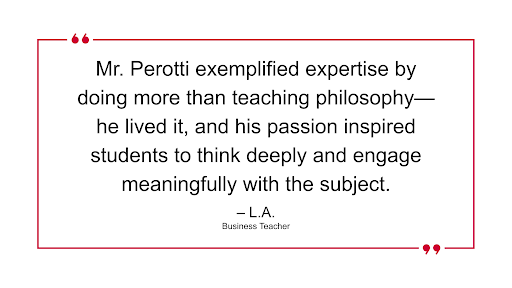
“Mr. Perotti exemplified expertise by doing more than teaching philosophy—he lived it, and his passion inspired students to think deeply and engage meaningfully with the subject,” Adams said, whose decision to join the teaching profession is a clear testament to the influence of educators like Mr. Perotti.
Social Studies teacher candidate Matthew Gessner provides another example of an expert teacher investing in their students. Gessner’s high school history teacher, Mr. Gangi, completely changed his outlook on teaching. When Gessner took Mr. Gangi’s class, he had already been accepted to Rutgers, and high school graduation was nearing. While most students were checked out with “senioritis,” Gessner stayed tuned in, visualizing himself following in Mr. Gangi’s footsteps.
“Mr. Gangi’s passion towards the class, teaching, the subject matter, and his students would inspire me so significantly that I truly wanted to be like him when I entered the professional world.”
Like Mr. Gangi, Gessner intends to show his love and passion for the subject matter while extending care and time to his students. He hopes to have an equally exceptional effect on students.
Building Relationships That Foster Success
Expert teachers can build meaningful relationships with students, creating an environment that supports growth and learning. These educators do more than simply share knowledge; they connect with students on a personal level, encourage intellectual curiosity, and inspire a genuine love of learning.
The impact of strong student-teacher relationships extends beyond the present moment, leaving a lasting impression on students’ futures. As aspiring teachers observe the powerful effects of these connections, they are motivated to adopt similar practices and shape their own teaching styles accordingly. In this way, the influence of expert educators continues, passing from one generation of teachers to the next. The teaching candidates below reflect on the practices of expert teachers they have admired as students.
Another significant story comes from Theresa Featherston, an ESL Teacher. She describes her eighth-grade math teacher, Anne Marie Smith, in one word: outstanding. Featherston classifies her as an expert teacher who was passionate about her students, teaching, and, of course, math,
“She took the time to get to know each student on a personal level,” Featherston said. “Each day, she would spend at least ten minutes chatting with the entire class about her previous evening and ask the class about theirs."
Ms. Smith was adept at reading the room and establishing strong bonds with her students to foster successful learning outcomes. Featherston fondly remembers that Ms. Smith took time with each student and tailored her teaching style to meet their needs, often coming in early or staying late to provide one-on-one attention. Featherston never had a day when she and her classmates didn't look forward to her class. According to Featherston, even students who did not like school or math enjoyed her class.
Aspiring Social Studies teacher Daniel Zachuk shares an engaging report on his relationships with expert college professor Dr. Woloson. Dr. Woloson was understanding and announced her policy during the first class meeting: to help students complete assignments successfully by offering flexibility.

Zachuk recalls Dr. Woloson stating, “If you have a hard time getting the paper in on time, come see me, and we will work something out, and you will lose no credit.”
She gave Zachuk, who disclosed his learning disability, extra time on every assignment when he requested it, and he never lost any credit so long as he submitted by the agreed-upon date. He never abused the system, and sometimes even handed in papers early. Zachuk recalls that although Dr. Woloson was flexible, she was firm with students about making advanced arrangements for delayed submissions.
"At the end of every class, people would try to hand papers in late, and she would not accept them because they did not talk to her ahead of time.”
Once, a student stormed out of Dr. Woloson’s office, fuming and seeking Zachuk’s agreement, “Isn’t she awful?” Zachuk responded, “She is wonderful.” The student was angered and rushed off, incensed. Zachuk consistently attended his professors’ office hours whenever possible.
Today, he still keeps in touch with Dr. Woloson and has taken his own children to her office for periodic visits.
Creating Meaningful and Engaging Learning
Boredom is a common challenge in schools. It can lead to disengagement and even dropout, which may limit a student’s future potential.
One effective way to combat boredom is through engaging instruction. Lessons led by dedicated teachers can have a lasting impact on students, influencing not only their immediate academic performance but also their long-term growth and success. When teachers create learning environments that capture students’ attention and spark curiosity, they encourage a love of learning, strengthen critical thinking, and build a desire for knowledge. Engaging lessons do more than simply present information; they inspire students, motivate them to explore new ideas, and develop skills that reach far beyond the classroom.
Shino Chung, a music teacher, focuses on how a general music teacher that she observed was an expert at curating engaging lessons for their students. Chung was pleasantly surprised to see the cooperating teacher challenging students to learn a song in a foreign language.
“At first, I thought the students might have difficulty because the language was unfamiliar to them,” Chung said. “However, the teacher did much more than simply ask students to repeat the lyrics. She explained the cultural background of the song and used a variety of activities and demonstrations to help students learn the rhythm and pronunciation naturally.”
Chung also discussed the teacher’s patience and encouragement of productive struggle.
“When students had difficulties, she did not immediately give them the answers. Instead, she asked questions that encouraged them to think for themselves.”

The way her cooperating teacher combined movement with the song, encouraged student participation, and adjusted the lesson based on students' responses inspired Chung, who found the activities simple but very effective at keeping students focused and engaged.
Classroom engagement also inspired candidate Darlene Bazil. One of her own teachers, Mr. Joseph, stands out as an expert, especially in curating captivating lessons. Bazil’s middle school Math teacher consistently demonstrated many remarkable teaching qualities. He did more than simply teach math skills. He understood how to motivate students and make learning fun and meaningful. He provided detailed feedback that helped students improve, encouraged critical thinking, and adjusted lessons based on student needs.
Mr. Joseph noticed that Bazil was competitive, as were others in the class, and created competitions for them to participate in. Students felt respected and capable. What made him an expert teacher was not just his years of experience, but his ability to influence student growth and confidence. Even years later, she still remembers the skills and lessons she learned in his class because of the impact he had on his students. Even today, when engaging with her students, she thinks to herself, “What would Mr. Joseph do?”
Cultivating Structure Through Effective Classroom Management
Effective teaching extends beyond delivering content; it requires thoughtful management of classroom behavior. Educators who excel in behavior management cultivate environments where students feel supported, engaged, and confident in taking academic risks.
By setting clear expectations, maintaining consistent accountability, and offering intentional positive reinforcement, teachers lay a foundation for both learning and personal growth. These classroom management essentials not only strengthen classroom dynamics but also help students develop essential social-emotional skills, including self-regulation, resilience, and collaboration. In turn, students gain the tools needed to navigate challenges, build meaningful relationships, and succeed both inside and outside the classroom.
Social Studies teacher Shaun Devlin reflects on his experience observing two educators who demonstrated exceptional skill in managing challenging classroom behavior: Dean Circello and Mrs. Young.
Although his time with them was limited due to the demands of the school environment, each observation and every piece of feedback they provided proved invaluable. Mrs. Young, a performing arts teacher, stood out in particular for her mastery of classroom management. Given that her classes involved coordinating student dance routines and physical performances, one might expect significant chaos. Instead, she maintained a structured, safe, and productive environment for all students. Even those who struggled with restlessness in traditional classroom settings were notably focused, respectful, and engaged during her lessons.
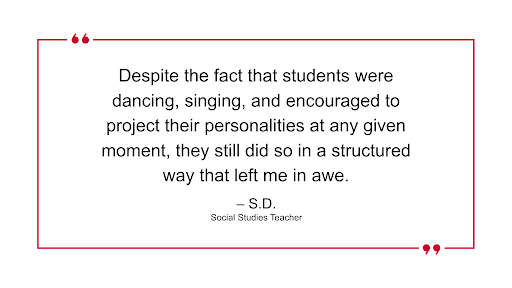
“Despite the fact that students were dancing, singing, and encouraged to project their personalities at any given moment, they still did so in a structured way that left me in awe.”
Her ability to channel energy into purposeful activity exemplified the impact of strong behavioral leadership in the classroom. History teacher Dean Circello was equally impressive in managing student behavior. He maintained order wherever he went and handled unimaginable scenarios with ease. His ability to teach a lesson and encourage students to engage with the subject material was incredible.
“Despite the fact that he had the class disciplined as if he were a naval officer, he still brought smiles into the classroom and created an environment that students actively looked forward to learning in," Devlin said.
These teachers inspired Devlin, and his time with them was invaluable to his growth.
Chemistry teacher Luisa Ospina remembers fondly her high school mathematics teacher, who had recently transitioned from an engineering-related job. She has been a major inspiration for what Ospina seeks to accomplish as a teacher, particularly in creating the best classroom environment for learning.
"My high school math teacher always had such a positive attitude and was set on making the classroom as happy and active as possible while still finding ways to redirect students who often got distracted or would cause distractions.”
She describes the industrious classroom culture, noting, “There was always a routine as soon as we stepped into the class to take out our homework and compare our answers, which we would then review as a class.”
Ospina felt the warm, demanding nature of her math teacher, noting that her friendliness with students was matched by an intentionally firm response to tardiness, class interruptions, or other displays of disrespect.
The influence of exceptional teachers extends far beyond the classroom.
As masterful architects of learning, they shape their students' life trajectories and light the way toward a brighter future. They build meaningful relationships that create safe, supportive spaces where curiosity flourishes, and students feel empowered to take intellectual risks. Skilled in classroom management, these educators tailor their approaches to meet diverse needs, cultivating the next generation of innovators and leaders.
As these candidate reflections demonstrate, they also spark students’ interest in teaching itself—highlighting the profound role educators play in student development and in strengthening the pipeline of new teachers.
If you’re considering following your dream of teaching, Rutgers Alternate Route can offer you the support and training you need to succeed. Be sure to follow Rutgers Alternate Route on Twitter and sign up for Alternate Route’s monthly newsletter for more information and stories from the field of education.
 Kafi Rosenbaum is a recent graduate of Spelman College, where she earned a Bachelor of Arts in English with a concentration in Writing. A writer and creative communicator, Kafi is passionate about storytelling that informs, engages, and connects audiences. As a Summer 2026 Content Creator Intern with the Rutgers Alternate Route program, she uses her passion to help support the program’s content and communications efforts. She also supports Black Star Communications through published works created in collaboration with the program.